#ai
21 entries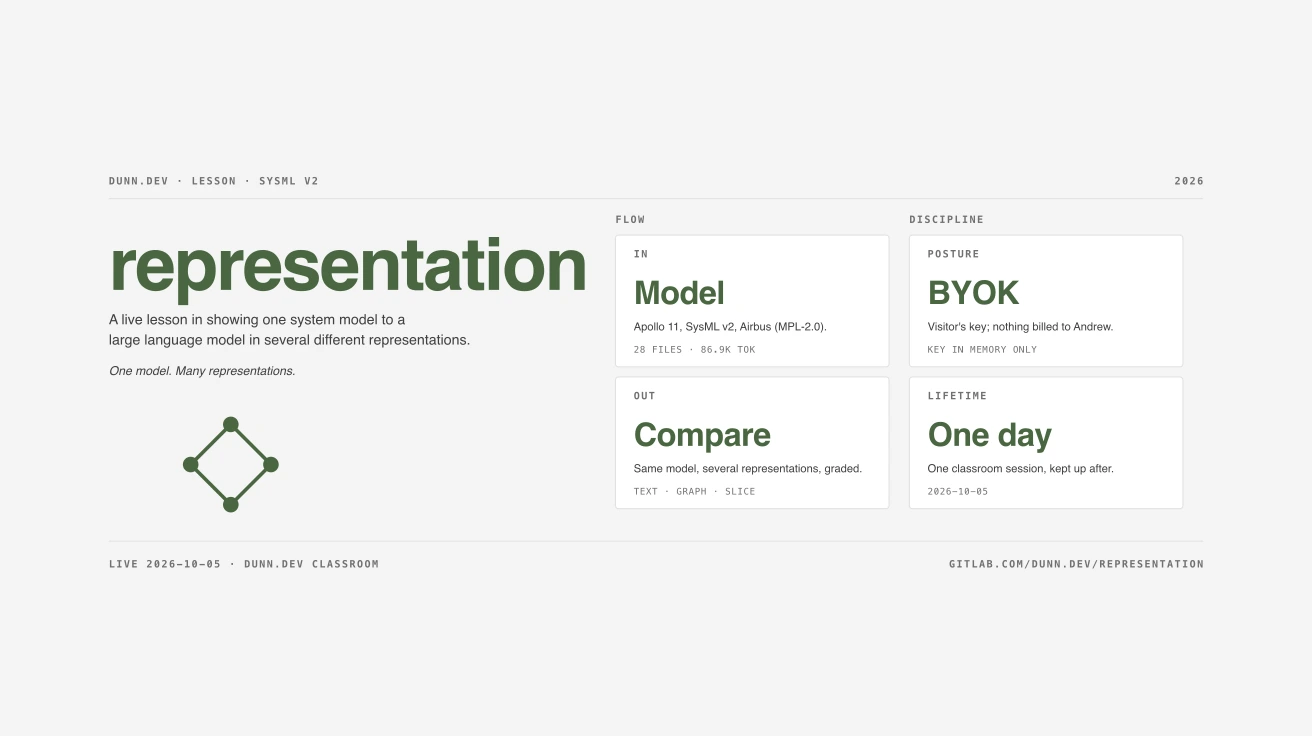
lesson · September 2026
Representation
See how the same question about the Apollo 11 SysML v2 model changes in tokens, cost and correctness as the representation changes, over recorded runs or live with your own key.

writing · September 2026
Operationalizing Ontology with Language Models
Projects co-written with language models grow semi-structured data that drifts. An ontology is one approach to consistency I wanted to investigate: what one is, how to run a program over it, what that buys, and the small experiment I designed to find out.

lesson · August 2026
Ontology
Operationalize an ontology with a language model. Give the agent a small model of the kitchen instead of a list of what is in it, so that three sizes of model give the same correct answer, and check the kitchen model with a script, because it is only worth having once something checks it.
projects · April 2026
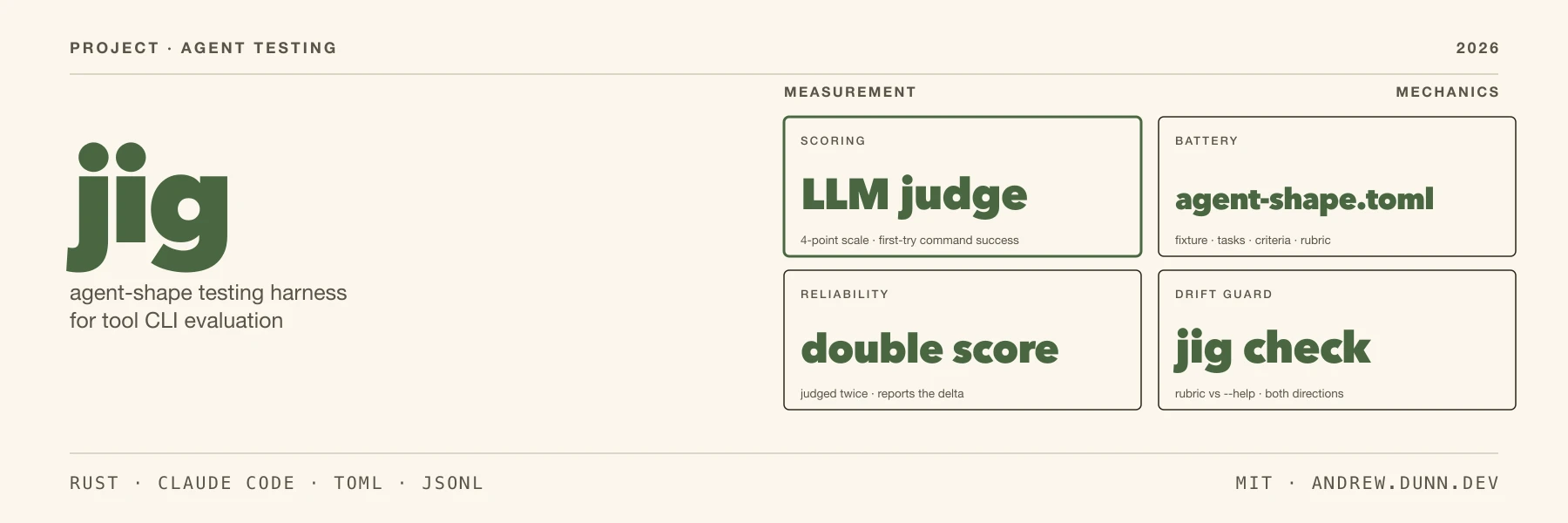
jig
An agent-shape harness that points a real agent at a real CLI and counts what happens: a battery declared in agent-shape.toml, a headless runtime spawned against the fixture, and an LLM judge scoring the transcript on a 4-point scale whose top mark is a first command that was real and worked. A companion check guards the rubric against drift in the tool's own help output.
writing · April 2026
The Larder Lesson
A scrollytelling lesson that builds a small AI harness around meal planning in Claude Code. An applied companion to the AI harnesses series.
lesson · April 2026
Larder
Build a small assistant for dinner out of one agent and a folder of plain files, and learn the shape that transfers to most of the other things you keep doing by hand: when the answer is wrong, correct the file, not the answer.

writing · April 2026
Inference on a Schedule
A nightly CI pipeline that mixes Python and a language model to keep a static site's activity data fresh. The interesting part was discovering which 10% of the work actually needed a model.
projects · April 2026
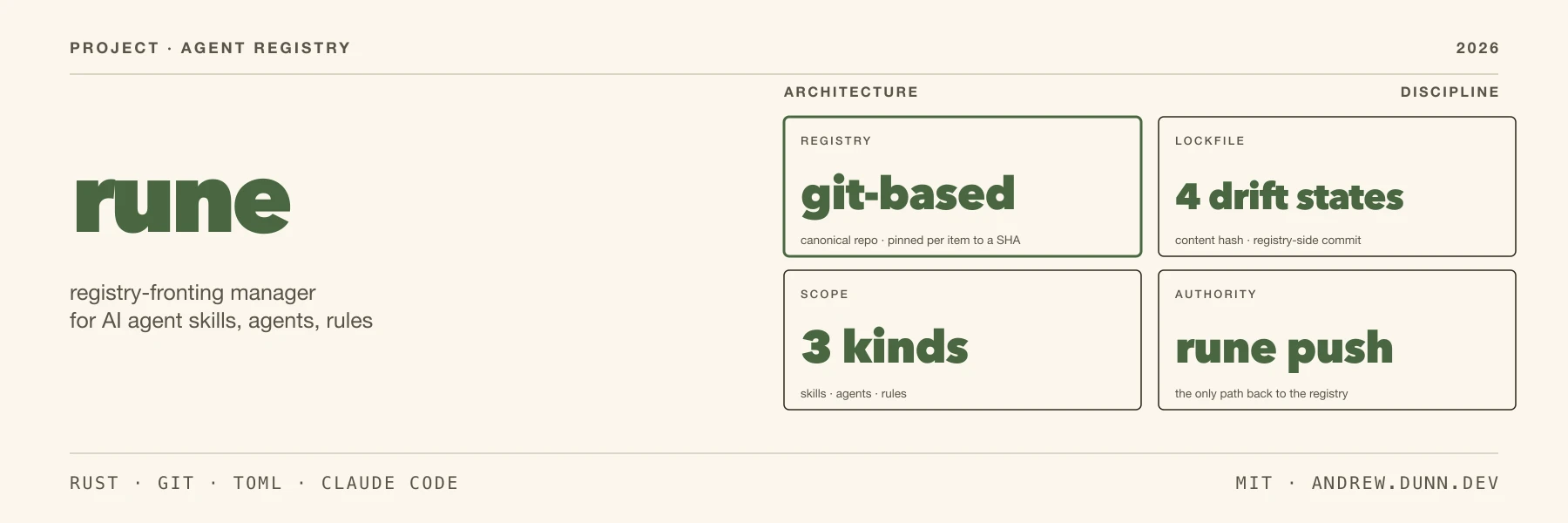
rune
A Rust CLI that treated a git repository as the canonical home for an agent's skills, subagents, and rules, syncing them into each project's .claude directory behind a content-hash lockfile and a write hook that surfaced drift in the same turn as the edit. Retired once the portable SKILL.md layout made most of what it did a directory of markdown and a symlink.

writing · April 2026
The Hunt for Leverage
On test frameworks that tell agents what to do next, and the design patterns that make LLM-generated tests actually correct.

writing · March 2026
Get Lamp
On dark software factories, where they work, where they might not, and a tool we built to explore the gap.
projects · March 2026
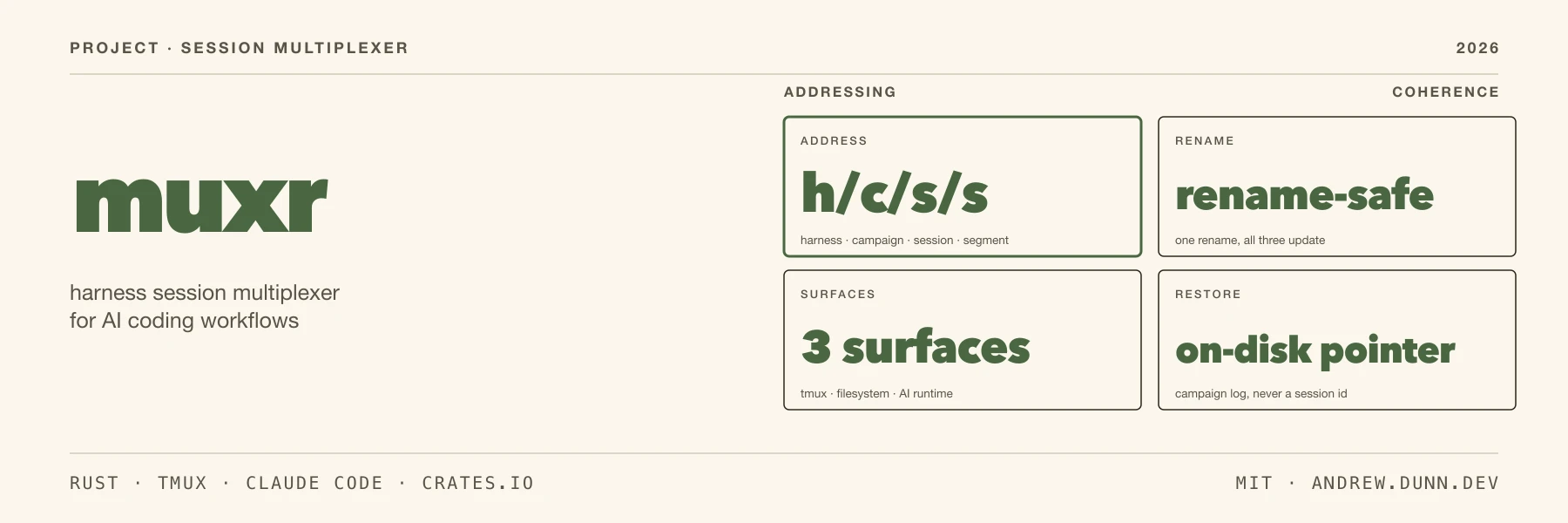
muxr
Harness session multiplexer for AI coding workflows. Owns the harness/campaign/session/segment address across tmux, the filesystem, and your AI runtime so a rename stays coherent in all three.

writing · March 2026
AI Harnesses Are For Everyone
A harness is a set of files that turns a stateless AI model into a persistent collaborator. The major labs are racing to move inference closer to your work. Here's how to meet them halfway.

writing · March 2026
LLM-Mediated Experimentation
Giving an LLM access to a real test bench transformed a year-old debugging effort. The root cause was not what anyone thought.

writing · March 2026
Go Architecture for LLM-Maintained Codebases
Structural choices in a Go project built mostly by LLMs: making wrong code fail to compile rather than fail code review.
projects · March 2026
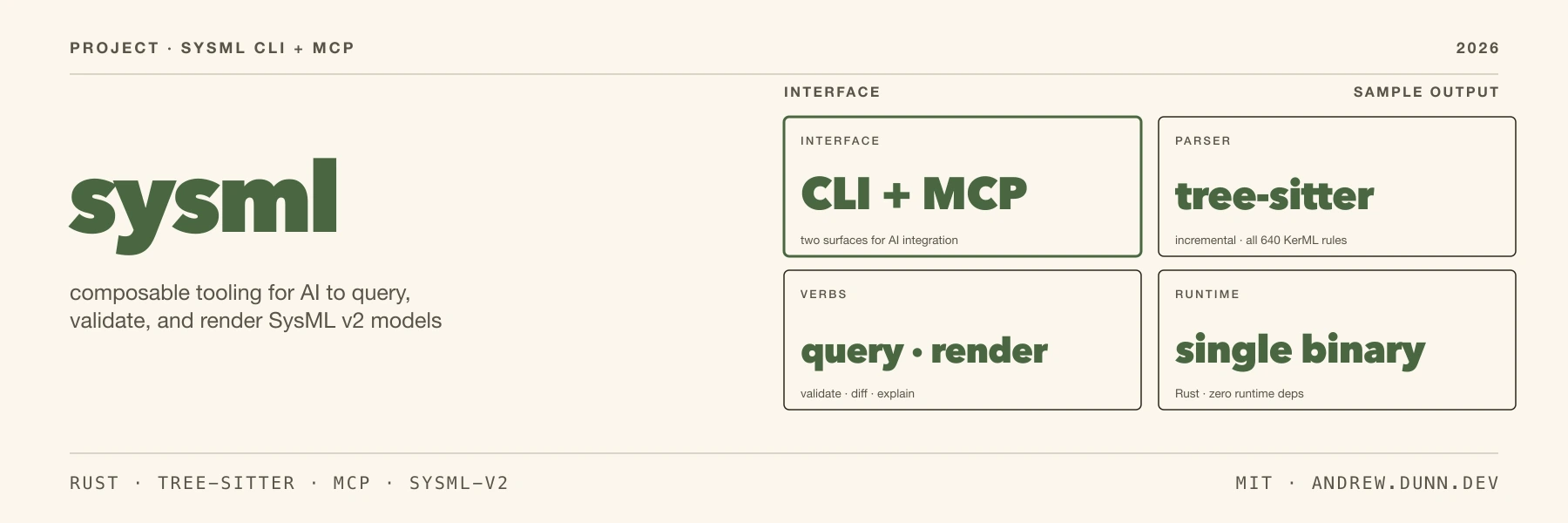
sysml
A single Rust binary that parses SysML v2 models into a queryable knowledge graph, exposed through a clap CLI for humans and CI and a stdio MCP server for agents, both over the same core. The open question is whether the CLI is the cheaper transport for an agent, and I have not measured it yet.
projects · March 2026
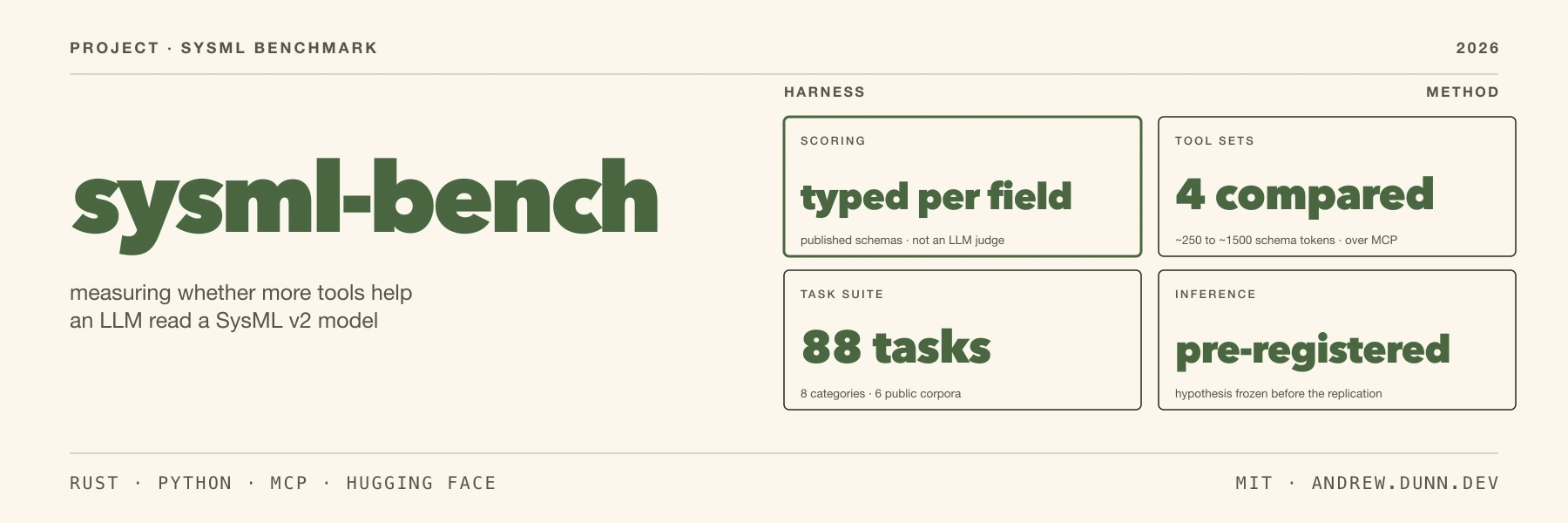
sysml-bench
An evaluation harness asking whether giving a tool-augmented LLM more tools actually helps it answer questions about a SysML v2 engineering model. 88 tasks scored per field against published schemas, run across four tool sets and six public corpora, with a pre-registered replication whose frozen hypothesis did not survive the independent corpus.
projects · March 2026
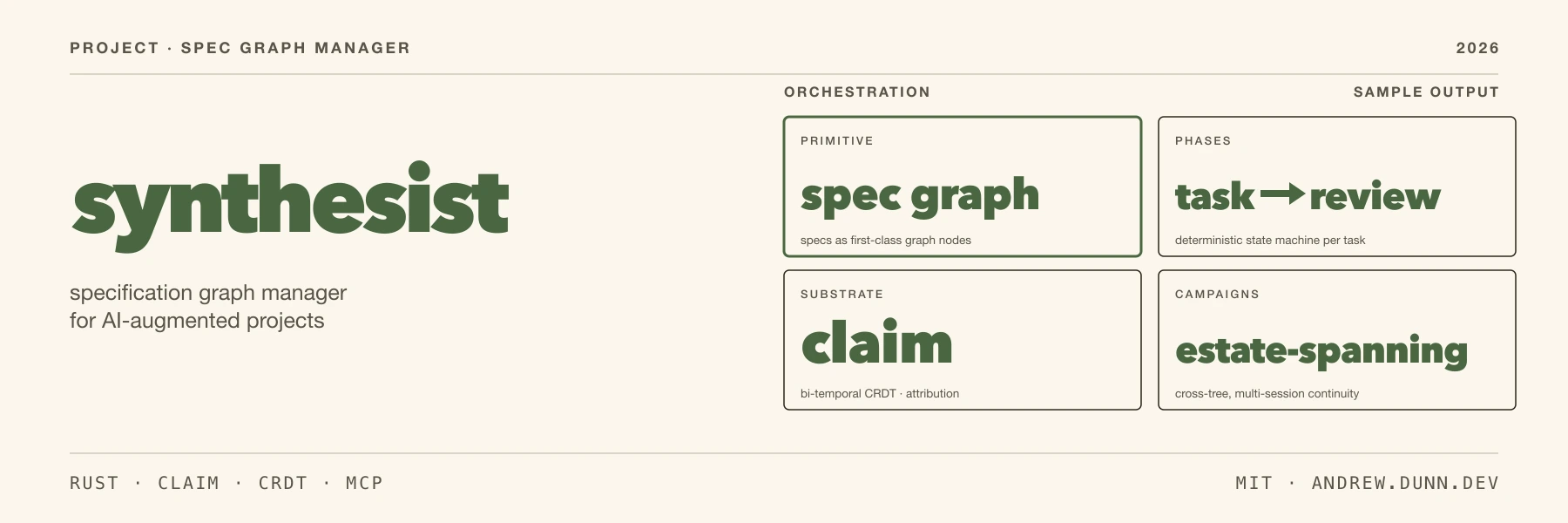
synthesist
A Rust CLI that records the process governing a body of code (what was planned, what was agreed, what phase the work is in) as an append-only claim graph an agent can query instead of inferring from a diff. Workflow state is a per-asserter JSON-LD log read back through a disposable index, under a phase machine that forbids every write until a human approves the plan.

writing · March 2026
Back to Composable
On why the agent tooling ecosystem is rediscovering the Unix shell, and why MCP is starting to look like Maven.
writing · February 2026
The Merge Request as {Friction, Leverage}
The merge request is both the thing slowing teams down and the thing keeping them safe. That tension is real and worth sitting with.

writing · February 2026
Self Inventory
Between dropping off the kids and my first meeting I built a scrollytelling analysis platform. What does that mean for the skills I spent years developing?
projects · February 2026
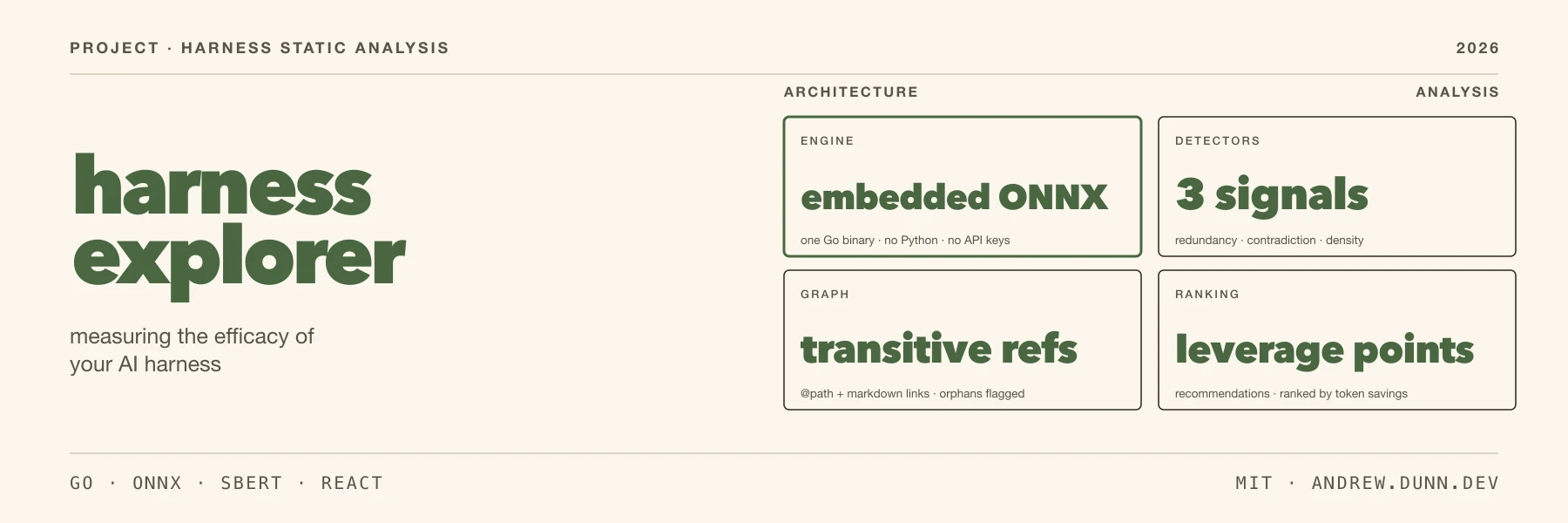
Harness Explorer
Static analysis for the AGENTS.md, CLAUDE.md, and skills files that define how an agent behaves in a codebase. A single Go binary follows their references into a knowledge graph, scores it for redundancy, contradiction, and information density, and ranks where the next hour of harness editing saves the most tokens; whether that ranking approximates what matters is untested, since no calibration dataset exists.