egress
A self-managed GitLab instance is not silent on the network. Service Ping, license checks, Duo, package-registry proxying, webhooks: each has its own outbound story, and each differs in what it sends, who can enable it, and whether an allowlist gates it. In a controlled-egress or air-gapped environment, every one of those connections needs a justification that a firewall reviewer or an accreditor can check before it is allowed to exist.
The starting question was whether that could be answered as data rather than as prose. GitLab’s own documentation covers the pieces, spread across the page for each feature and written once for a first read. Answering “is this safe for my environment” one modality at a time, from documentation scattered across products, does not scale. What a reviewer needs has different properties: one profile per deployment form, every destination carrying a version-validity range, a ledger recording when it was last checked and against which release, and a citation to go re-derive instead of a claim to take on trust.
The build is where that gets interesting, because the same machinery has to serve both the first assessment and every re-assessment after it.
Nothing in that loop is a one-time artifact. A red tripwire is a work order rather than an alarm, and because re-derivation appends to the same ledger the renderings already read from, a profile cannot quietly become a snapshot of whatever release happened to be current the day it was written.
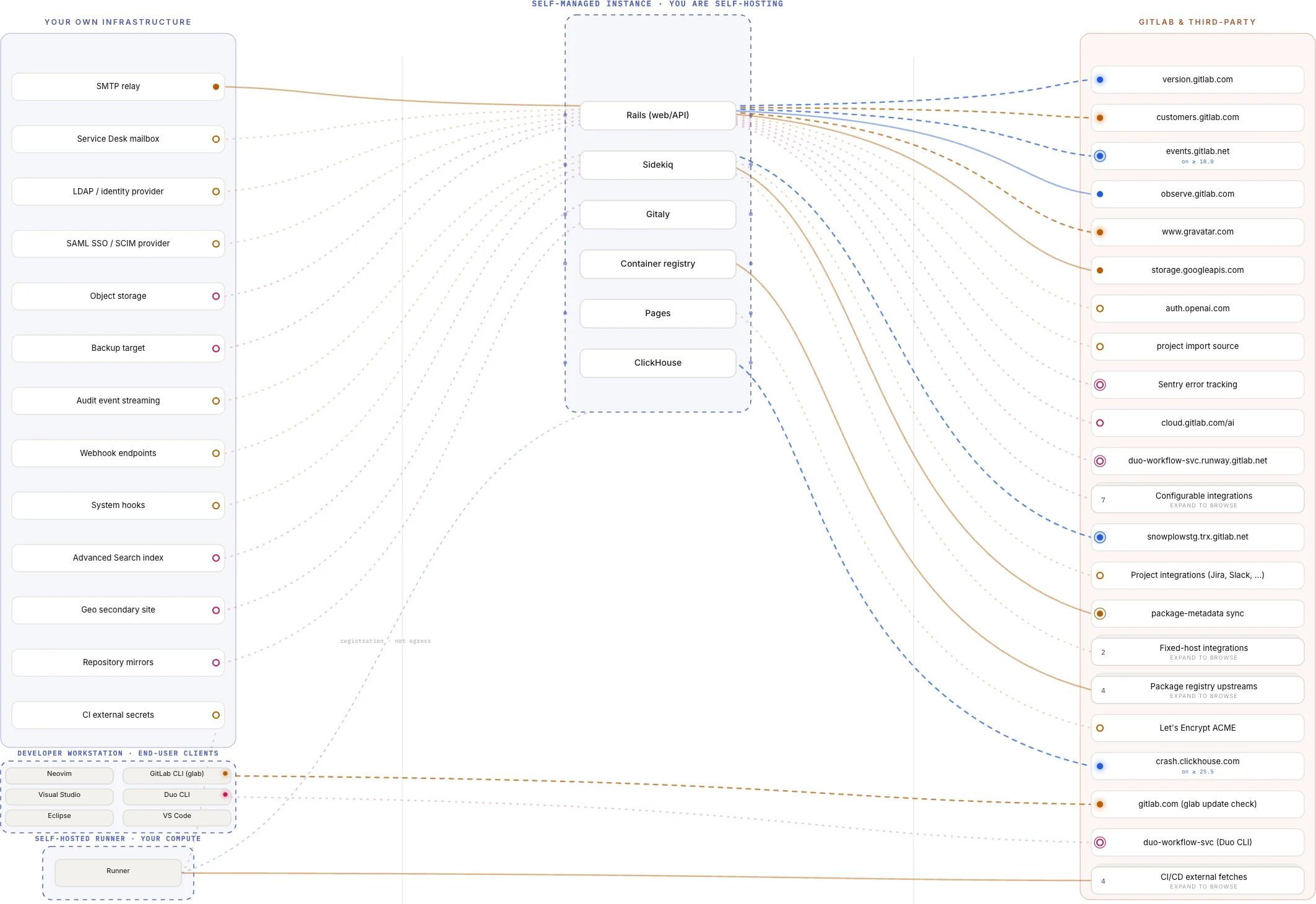
egress covers self-managed GitLab only, not GitLab.com, and I draw the line at the runner’s own infrastructure: what a user-authored CI job sends over the network is that job’s business, not the platform’s, and it is a stated non-goal rather than a gap to close.
The conformance-contract shape, a declared standards file plus a component that checks it, looks like the part worth carrying to anything meant to outlive a single maintainer, and evidence-factory is where I carried it next: its three consumer repos are seeded on the same report, cutover, enforce ladder egress uses for its own conformance contract.
varve asks a much smaller version of the same question, of one machine instead of a platform, where the answer it has to keep proving is that nothing leaves at all.